Teaching Career Archive
While working as a teacher, I used this site primarily as a record of some of my teaching career. Below is a condensced form of the older version of this site.
Philosophy
In the classroom, my students called me "Teacher" or "Teacher B". I believe that education should be empowering and that learning should be gratifying. I want all my students to be able to explore science in meaningful and relevant ways, and approach the problems they face in and out of the classroom with curiosity and confidence. To this end, I understand that the science classroom is much more than the theories discussed within, it is driven by the relationships between students and teacher. I want my classrooms to feel like a home space, where students are able to express themselves genuinely and can trust me and each other to listen to what they have to say. When students and teachers trust each other, the exploration of the natural world and deep science concepts becomes enlightening, not mystifying, and students learn to approach difficult problems with confidence.
I regard the practice of pedagogy in the same manner I regard the practice of science; in that it is an iterative process and never a finished product. I am always keeping my students in mind as I adapt lessons to the specific tone of each class I teach. I am constantly working to understand and redress the barriers that keep students from succeeding, whether that be at home, in school, or in my classroom. To that end, I work to creatve inquiry-driven activities and center my students' voices so that they may burgeon into confident adults and lifelong learners.
Reviews of Teaching Literature
I read a lot to help improve my teaching. Here is a link to a log of all the relevant works I have read, along with breif summaries and commentary. Most I can recommend, with a few exceptions.
P Phyiscs(SC362)
This class was the second year of physical sciences, and focused on traditional physics concepts such as Newton's Laws, energy, the forces of gravity and electromagnetism, and studies of wave properties (including the wave-particle duality of light). In this class students continued to build upon their labratory skills, and gained experience using more robust mathematical tools for analysis and critical thinking.
P Chemistry (SC350)
This class served as an introduction to the physical sciences and the basics of chemisty. Broadly, the big ideas we cover as the conservation of energy and matter, the atomic structure of matter, the dynamics of chemical reactions, and how these chemical and physical processes shape the dynamics of the Earth's various systems. I taught students how to plan and carry out experiments in our lab space, how to gather and interpret data, and how to be responisble and communicative scientists.
AP Computer Science Principles (MA214)
Course Description: AP Computer Science Principles is a one-year, college level, non- calculus based introduction to the central ideas of Computer Science. The course introduces students to the foundational concepts of computer science and challenges them to explore how computing and technology can impact the world. The AP Program designed AP Computer Science Principles with the goal of creating leaders in computer science fields and attracting and engaging those who are traditionally underrepresented with essential computing tools and multidisciplinary opportunities.
The curriculum for this class is taken primarily from code.org, but I made several additions and adaptions. On the right are a few of the lessons I have developed/adapted for this course.
Sample Lessons
Below are some of the lessons I created during my time at Napa High School. The last four I created during my student teaching at Piner High School in Santa Rosa.
- Drawing Dinosaurs Project and intro Slides - We used replit.com as the programming environment for this project. These types of 'turtle' projects are execellent introductions to coding in any language.
- Programming a Text-Based RPG - The final coding project for my class. Contains a rubric, planning guide, and intro/inquiry activity.
- Invesitigating Camera Lenses - Two shorter inquiry activities into the basics of how lenses work. With some great artistic opportunities!
- Investigating Waves on a Slinky- Another inquiry activity, this time on making measurements of basic wave behavior on slinkies.
- Anatomy of a Wave - A reading I gave at the start of our unit on waves in a physics class. Students annotated and used it as references as we made further inquiries.
- Final Project: Waves and Technology - The culmination of our waves unit. Aligns with NGSS HS-PS4-5. Here you can see the posters those students made for the final project!
Maker
As part of my professional development, I completed a Makerspace Certificate Program through Sonoma State. The goal of the program is to prepare teachers to bring the philosophy and tools of Makerspaces into traditional school and classroom settings. When adopted by a school this means creating a Makerspace on campuse and running Making classes, but as a single teacher my aim was to bring more maker-minded activities and philosophy to my classroom.
I have enjoyed tinkering my whole life; when I was a child I played with Legos and as I've grown I have had the opportunity to fiddle with 3D printers, build robotics/arduino projects, and dabble in numerous crafts both at my home and in the classroom. My grandfather shared many of the same interests, and was one of the first people to introduce me to Maker spaces. He was an electrical engineer, himself tinkering with innumerable projects over the years, and spoke to me often about how he believed engineering kits and workshops could enhance science education.
In that same vein, I believe that making (giving hands-on building and problem-solving experiences in the classroom) builds confidence and creativity in students. It provides more kinesthetic experiences and the chance to struggle productively in a low-stakes environment. By asking students to plan, create, tinker, break, and fix objects and structures, we are cultivating an sense of agency and grounding science learning in their everyday experiences.
Maker Activities in my Classroom
Capturing Chemical Energy
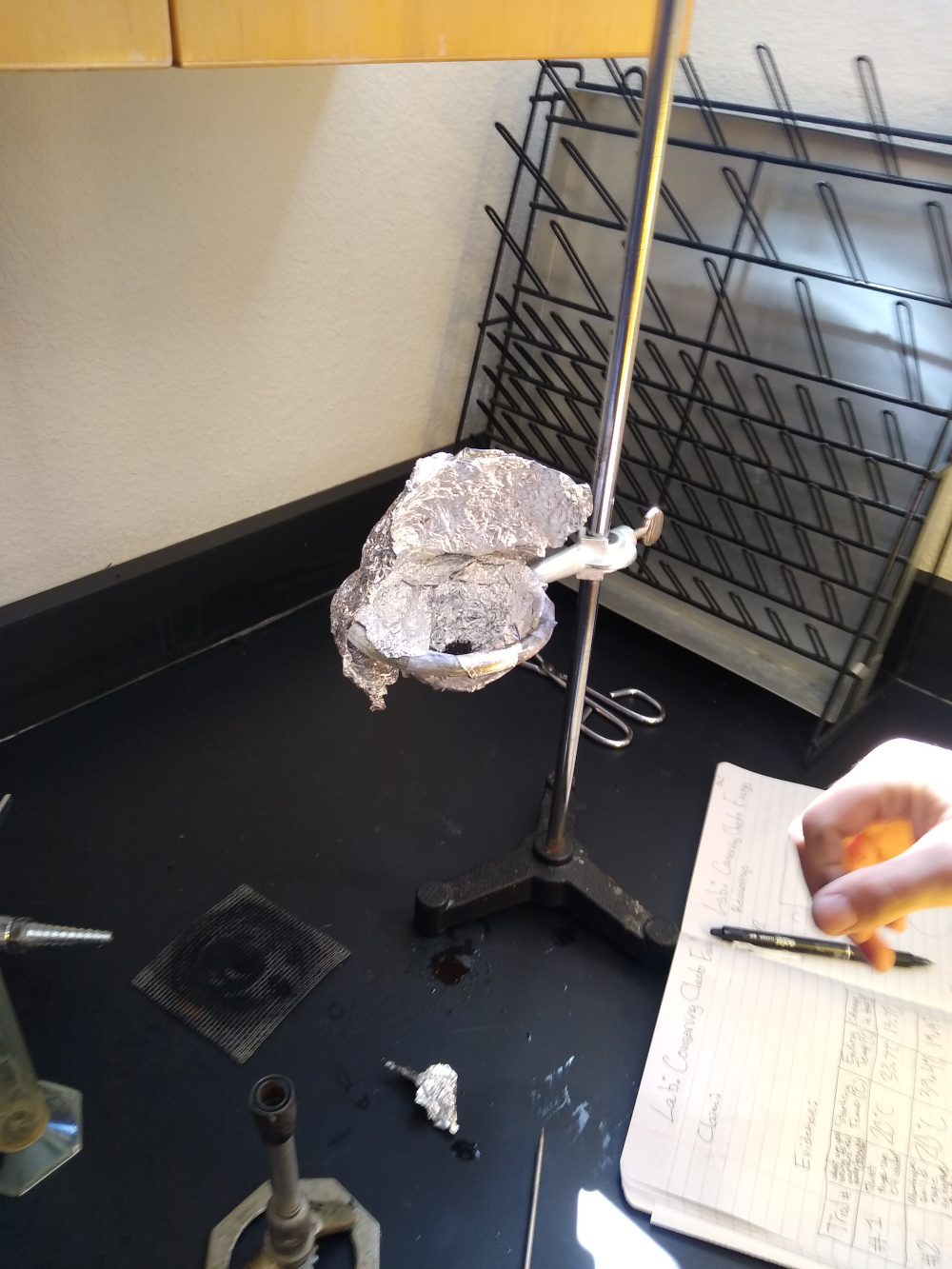
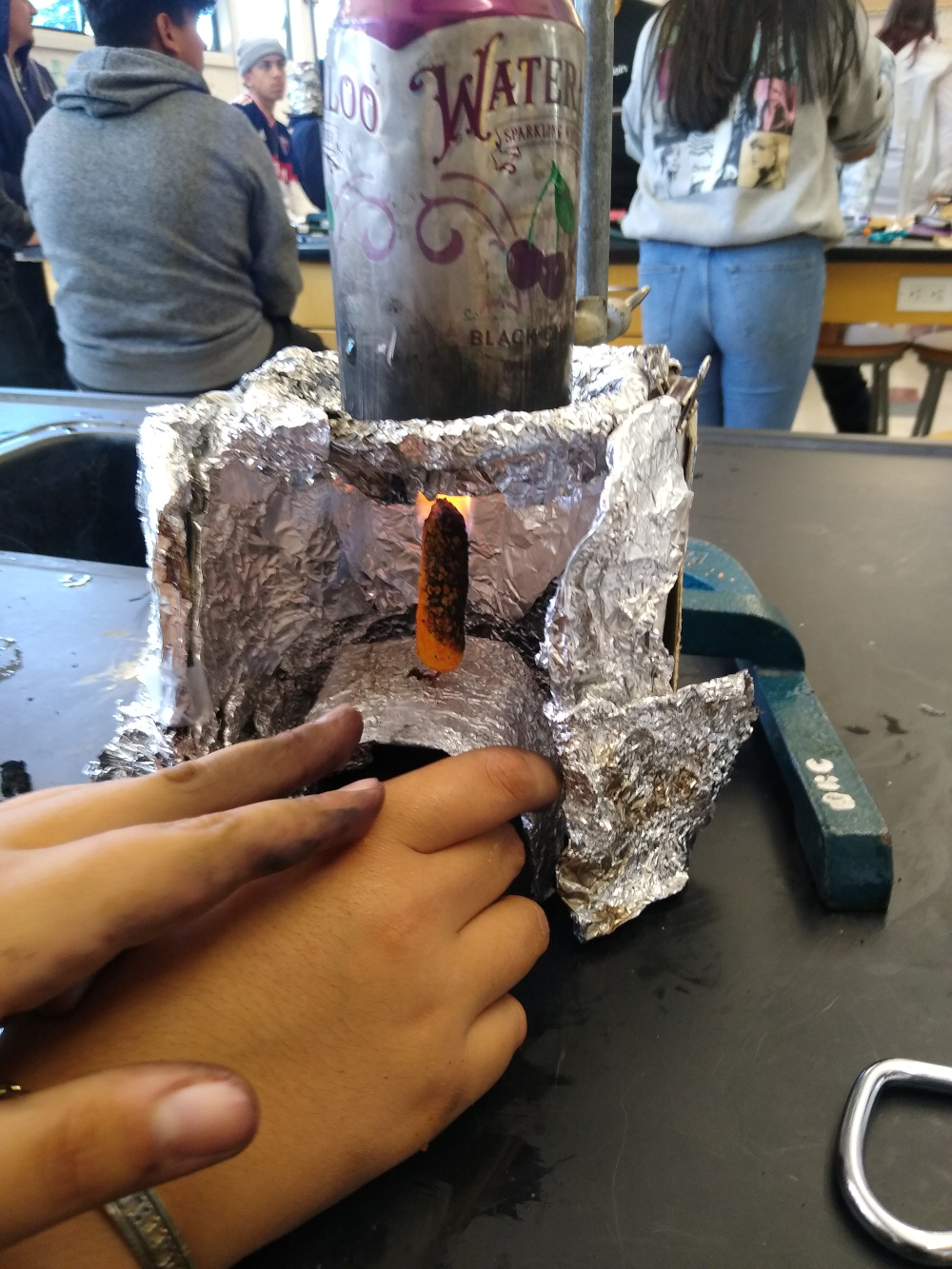
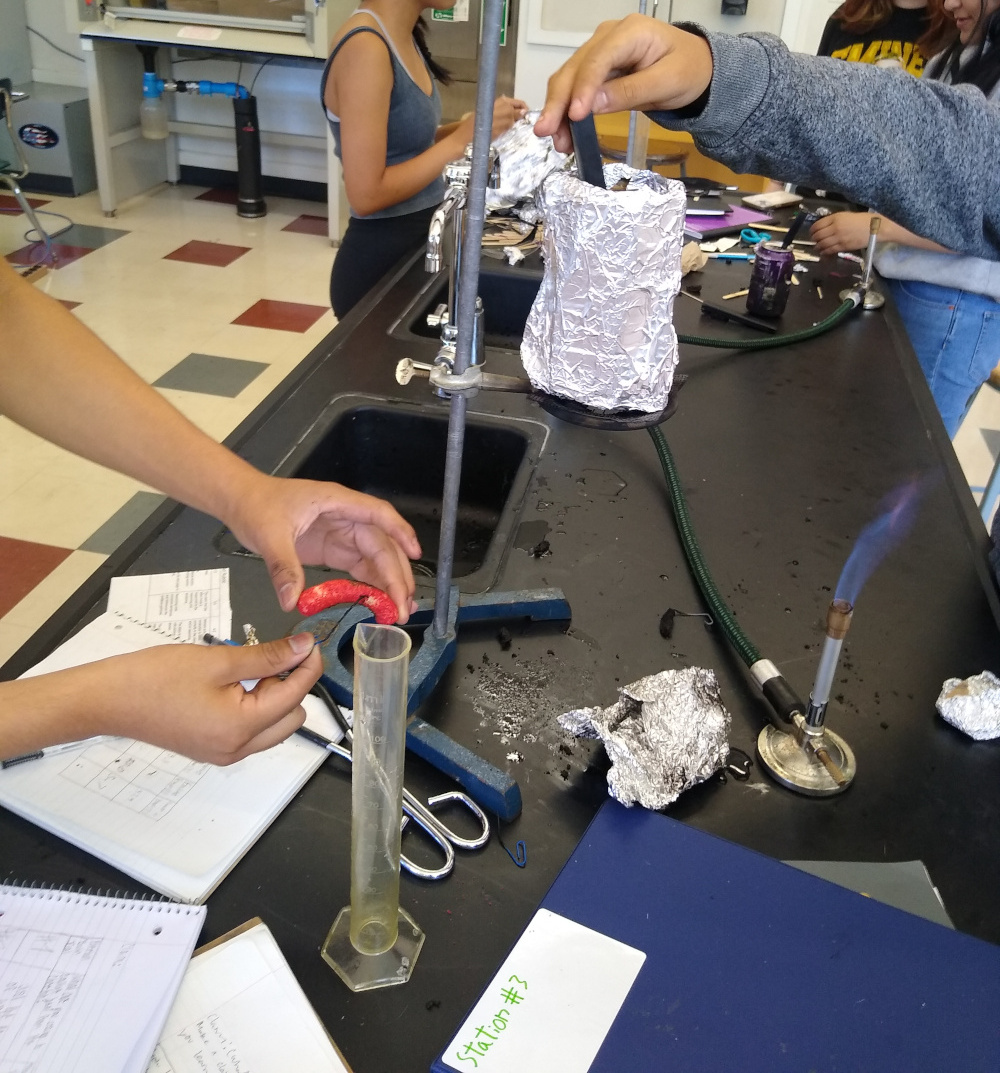
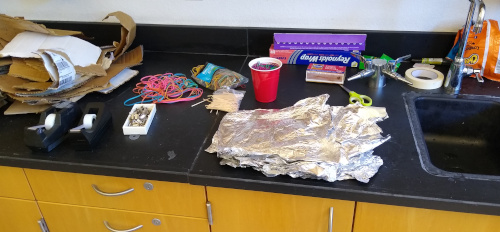
As part of a unit on Energy/Calorimetry (HS-PS3-1 and 3-4), students burned a cheeto under a can of water to measure how many calories of heat it could produce (and thus infer its chemical energy). Students were tasked with creating structures to capture as much energy as possible, and raise the heat of the water more with each test (they did around 3 to 4 trials). A fun enhancement to an otherwise passive lab! But I would not advice using rubber bands, and being sure to emphasize to students that they must insulate any cardboard they use.
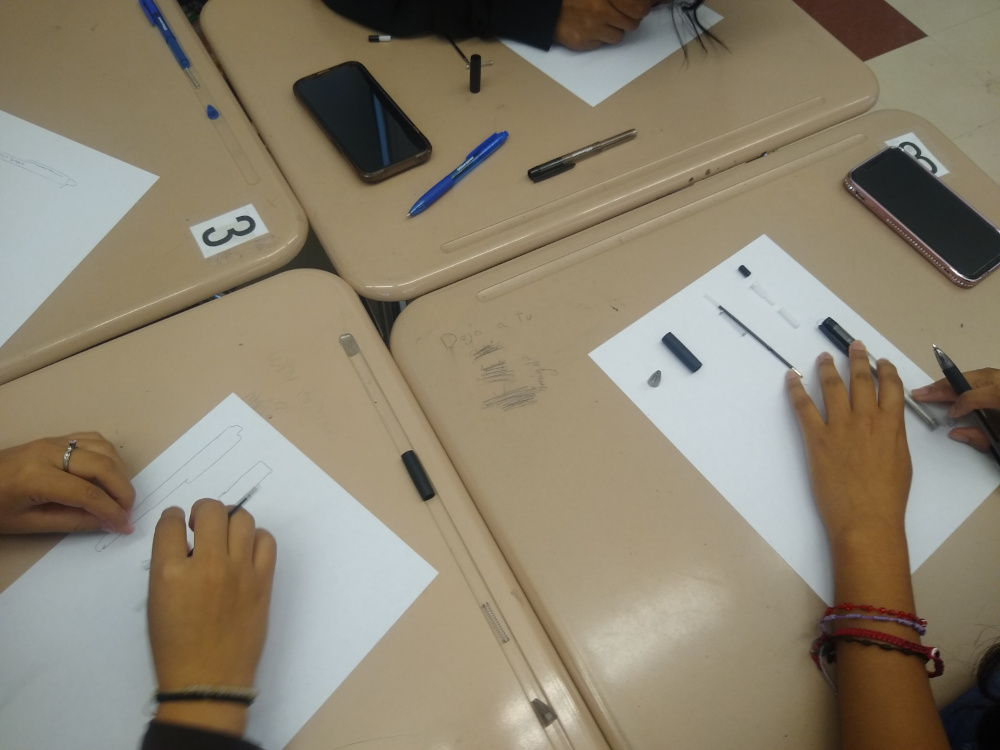
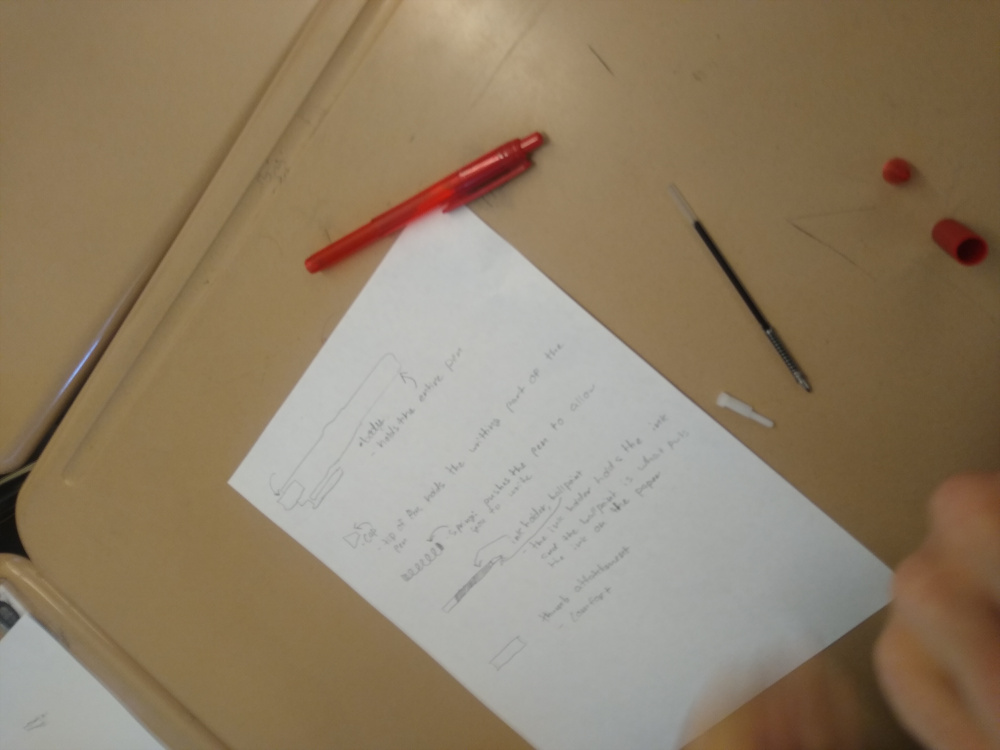
The Structure of a Pen
As an introduction to atomic structure, I had students take apart, label, and describe the pieces of ballpoint pens. It is a way to start thinking about structure, and the function of induvidual parts as part of a whole. This activity was shown to me as part of my Maker certification class, original posed as an exersize to get students thinking about how we live in a built world, it was easy to impliment and helped get students thinking about atoms as the "smallest pieces" they would get if they could take apart their pens totally.